
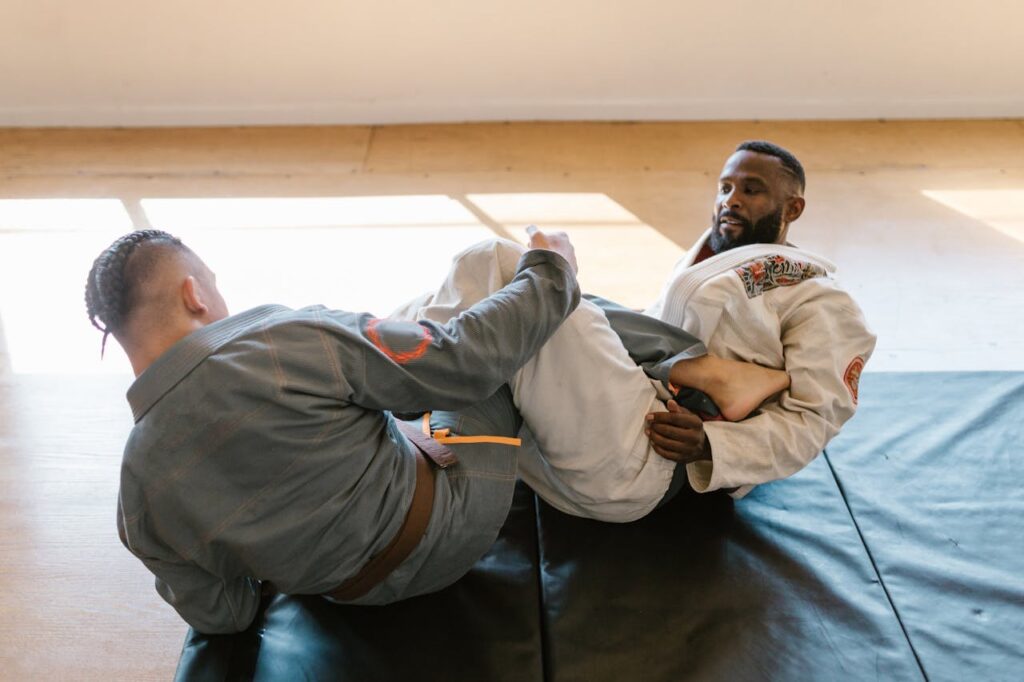
When learning Brazilian Jiu-Jitsu, beginners frequently concentrate on strength, technique, and positional control. The ability to switch between postures, change direction, and bridge distances under duress is known as explosive transitions, and it’s a skill that’s rarely acknowledged but distinguishes great practitioners from excellent ones.
Learning transitions is a high-leverage skill that speeds up your growth, according to Definitive BJJ in North Vancouver. Learn how to practice it, why it important, and how it can improve your BJJ skills.
🔍 Why Explosive Transitions Matter
Fill up the Gaps Under Duress
Rarely will your opponent allow you to move freely when you’re rolling. You can get past static defenses if you can change positions fast (from guard to sweep, from passing to mount, or from escape) when under pressure.
Efficiency of Energy
Transitions allow you to use momentum instead of using force for every movement. The more quickly you adapt, the less you have to directly combat resistance.
Control & Surprise
Opponents are caught off guard by an abrupt transition. That one second could mean the difference between dominating and getting trapped.
Quicker Compounding Skills
Every skill you master earlier gets easier to chain if transitions are smooth. From isolated moves to a flow machine, your game changes.
🎯 Training Methods for Explosive Transitions
Here are few techniques that Definitive BJJ has used or can use to develop this ability:
Chain Drilling Under Fatigue
Choose a chain with three positions (open guard → sweep → mount, for example) and run it 20 times straight, followed by another 20 when you’re tired. Under stress, your body learns to adapt.
Exercises Using Weights
To make you exert more effort during transitions, use a little resistance, such as a light band around your back. After then, take it off; your transitions will feel lighter.
Drills using Reaction Cues
When you transition, have a partner call or give you a signal (touch, hand gesture) so you have to quickly shift and react. Make it erratic.
Shrimp & Slow-to-Speed Bridge
Practice shrimping and bridges slowly at first, then quickly. In order to move or escape, use strong hip blasts.
Three minutes of live flow rolling without pins
The rule is to avoid settling in static holds when flow rolling. Pass, sweep, reverse, and reposition at any times. This improves agility and conditioning.
Reach Out Today!
